
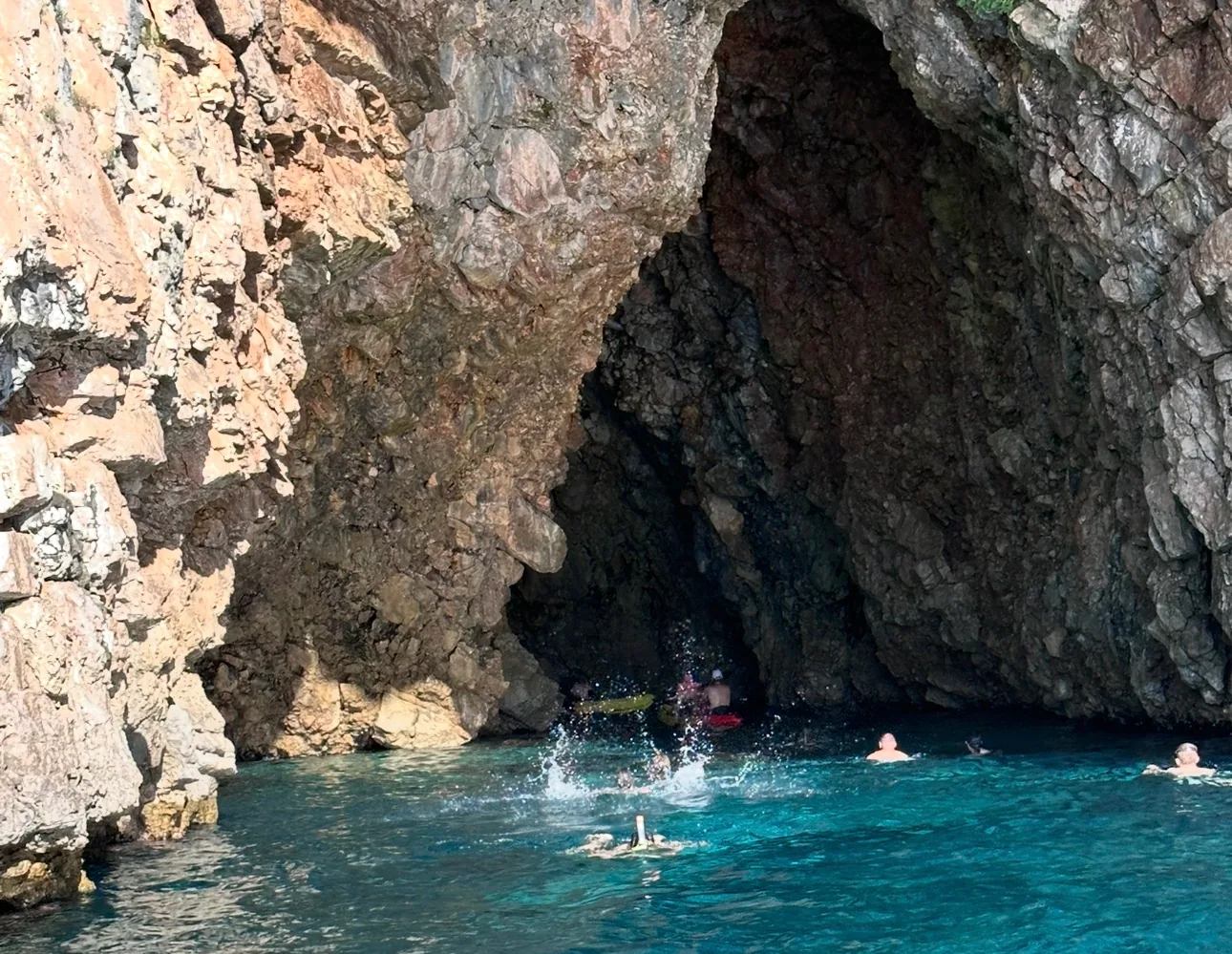
If you’ve seen photos of a cave glowing electric blue from the inside, you’ve already found your reason to take a boat tour in Montenegro. The Blue Cave (locally Plava Špilja) is a small sea cave on the Lustica Peninsula where sunlight passes through an underwater opening and lights the interior with an unnaturally vivid blue glow.
It’s one of those rare natural attractions where the experience is genuinely better than the photos. I’ve watched hundreds of guests walk in with low expectations after seeing online photos and leave the cave saying they had no idea it would look like that in person. Here’s everything I’ve learned from running boats to the cave since 2023.
How the Blue Cave gets its colour
The colour is pure physics. The cave has two openings: a main entrance above the waterline, wide enough for a small speedboat to enter, and a smaller underwater hole below the surface. Sunlight enters through the underwater opening, and the seawater acts as a filter — water absorbs the red end of the visible spectrum and lets only blue wavelengths pass through.
That filtered blue light then bounces off the white limestone floor of the cave and back up through the water, lighting everything inside from below. The result is a luminous, almost electric blue that seems to glow from beneath the surface. Objects in the water look lit from within. If you drop your hand below the surface, it looks wrapped in blue light. You can feel the effect on your face before your eyes fully register it.
The same phenomenon produces the famous Blue Grotto on Capri in Italy and the Blue Cave on Biševo Island in Croatia (more on the Croatia comparison further down).
Where exactly the Blue Cave is
The Blue Cave sits on the outer side of the Lustica Peninsula, on the open Adriatic coast just past the entrance to the Bay of Kotor. The coordinates are roughly 42.398°N, 18.566°E. It’s carved into the limestone cliffs that form the bay’s outer edge, opposite Herceg Novi across the bay’s entrance.
There’s no road access. The peninsula side near the cave is rough, undeveloped coastline — limestone cliffs dropping straight into water 20+ metres deep. The only way to visit is by boat. From Kotor by speedboat, the journey takes 45–60 minutes one way, passing through the Verige strait (the narrowest point of the bay) and along the southern shore of Lustica.
When to visit — timing matters more here than anywhere else in the bay
The blue effect depends on how much sunlight hits the underwater opening, which depends on the sun’s angle. That means timing matters in a way it doesn’t for most attractions.
Best time of day
10:00 to 11:30 in the morning. This is when the sun angle is high enough to fire light through the underwater hole at strength, but not yet so high that the angle goes vertical (which is bad — vertical light bypasses the cave entirely). Tours departing Kotor at 09:00–09:30 arrive at peak light. Tours departing at 11:00+ arrive past peak and see a duller, more teal effect.
Best months
May, June, July, August, September — all good. The sun is high enough during summer that the cave glows well from about 09:30 to 13:00.
July and August produce the most intense colours but also the busiest days at the cave (sometimes 4–6 boats queuing to enter). If you specifically want the cave to yourself, an early-morning May or September departure is the sweet spot.
April and October still produce a blue effect but it’s less intense — the sun angle is lower so less light enters. Worth visiting if you’re in Montenegro in shoulder season, but don’t make the cave your primary reason for a trip.
November through March — the cave is technically accessible on the rare calm winter day, but the effect is muted (low sun angle) and the water is too cold for swimming. Most operators don’t run cave tours in this period.
Weather conditions
The cave sits on the open Adriatic side, exposed to wind and swell. A calm sunny day is essential. The two weather conditions that ruin a cave visit:
Strong bura wind (the northeasterly that blows in cold fronts): makes the 10-minute open-water section past Mamula too rough for a small boat. We may delay departure by a few hours, substitute a Žanjic-only route, or postpone to the next day.
Heavy cloud cover: without direct sunlight, the cave looks merely grey-blue rather than electric. Still worth seeing on a partly cloudy day, but a sunny day is dramatically better.
If you’re booking a multi-day trip, give yourself flexibility — book a cave tour for one of your first days so you can rebook if the weather is wrong. Operators we recommend (us included) don’t charge for tours cancelled due to weather.
What to expect inside the Blue Cave
The cave entrance is roughly 4 metres wide and 3 metres tall — enough for a speedboat to enter comfortably, intimate enough to feel like you’re slipping into a hidden world. Inside, the cave opens into a chamber about 12 metres wide and similar in depth.
The first thing you notice after the colour is the silence. The cave muffles wind and outside sound, and the gentle lap of water against stone creates an almost meditative atmosphere. Voices echo softly. Then you look down at the water and the blue hits you.
Swimming inside is the main reason most people visit. The water is crystal-clear, around 22–24°C in July and August (cooler in shoulder season), and the blue effect is more vivid when you’re in it. Floating on your back, looking up at the limestone ceiling while the water below glows electric blue, is one of those experiences that stays with you.
Most tours spend 15–25 minutes inside the cave area. Long enough to swim, take photos, and let the experience really register. Other boats also visit, so we don’t linger longer than the experience needs.
Photography tips for the Blue Cave
The cave is unusually photogenic but most people leave with worse photos than they expected. Some tips that consistently work:
Use a wide-angle lens or your phone’s wide setting. The cave is small and the entrance frames the best shot. Phone wide-angle (0.5x on iPhone, 0.6x on many Androids) captures the whole interior.
Don’t use flash. It blows out the blue and ruins everyone’s photos including yours. Modern phone cameras handle low light far better than flash.
Get in the water with a waterproof phone case. Photos from inside the water, looking through the blue layer at the cave wall, are the best ones. €15–20 case is the best photography investment you can make for the trip.
Shoot raw or HEIF format if your phone supports it. The colour balance inside the cave fools most cameras into shifting toward green. Raw lets you correct that in editing.
Best framing: shoot from inside the cave looking toward the entrance, with someone swimming silhouetted against the blue. Don’t shoot from outside looking in — the contrast is too harsh.
Bring a small dive light if you have one. Pointing a white light at the cave wall while shooting reveals texture in the limestone that’s invisible to the naked eye.
How to book a Blue Cave tour from Kotor
Most visitors take a boat tour that combines the Blue Cave with other stops. The most common itineraries from Kotor:
3-hour Blue Cave tour: cave + Our Lady of the Rocks + Submarine Tunnel + Mamula photo pass. Best if you want the cave as the main focus. Our version is the Blue Cave Adventure for €320 per boat.
5-hour Blue Cave + beach tour: same stops plus 1 hour at Žanjic Beach for swimming and lunch. Best for families and longer half-days. Ours is the Beach & Cave Explorer for €400 per boat.
6-hour full bay tour: cave plus the inner bay (Perast and Our Lady of the Rocks proper stops) plus Žanjic lunch. The “see everything” option. Ours is the Full Bay Discovery for €480 per boat.
For all three, the principles are the same: book a morning departure, pay per boat (not per person), and book direct with the operator to avoid Viator/Klook commission (typically 20–30% cheaper).
If you want the deep operator-side breakdown of how to choose between these, see our Best Boat Tours from Kotor 2026 comparison — it covers all five routes side by side with pricing maths.
Blue Cave Montenegro vs Blue Cave Croatia — which is better?
Travellers who research the Blue Cave often run into a second result: the Blue Cave on Biševo Island in Croatia. The two are completely separate caves about 200km apart by sea. Quick comparison:
| Aspect | Blue Cave Montenegro (Lustica) | Blue Cave Croatia (Biševo) |
|---|---|---|
| Location | Lustica Peninsula, near Kotor Bay | Biševo Island, off Vis Island |
| Access from main tourist hub | 45–60 min by boat from Kotor | 2.5–4 hours from Split/Hvar |
| Boat type to enter | Small speedboat | Small rowing boat (paddled) |
| Tour length | 3–6 hours from Kotor | Full day (8–12 hours) from Split |
| Crowds | Moderate (5–10 boats per day) | Heavy (50+ boats per day) |
| Swimming allowed | Yes | Usually not (preservation) |
| Best light | 10:00–11:30 | 11:00–13:00 |
| Typical cost from main hub | €80–120 per person (group) or €320 private boat (4 people = €80 each) | €70–110 per person (group only) |
The Croatian cave gets more international fame because it’s older as a tourist attraction (visited since the early 1900s) and easier to reach in a day-tour package from Croatia’s big tourist centres. But the Montenegrin cave has two practical advantages: shorter day from your base, and you can swim inside. The Croatian cave forbids swimming to protect the limestone.
If you’re already in Croatia, visit the Biševo cave. If you’re in Montenegro, the Lustica cave is the one — closer, less crowded, and you get the swim.
What else to bring on a Blue Cave tour
Beyond the photography tips above, the essentials:
- Swimwear, worn under your clothes so you can jump in quickly inside the cave
- Towel (most boats don’t provide them in summer)
- Sunscreen and sunglasses — strong sun on the 45-minute open-water stretch from Mamula even on hazy days
- Light jacket for early-morning departures in May and October (the boat ride is cool before the sun warms up)
- Cash in EUR for the tour payment (paid to captain after) and €5 per person if you stop at Our Lady of the Rocks church
- Water shoes if you’re sensitive — the cave floor and rocks just outside are rough limestone
- Waterproof phone case — see photography section
Frequently asked questions
Is the Blue Cave Montenegro worth visiting?
Yes — it’s one of the most consistently impressive natural attractions in the bay. If you have at least half a day available in Kotor and the weather is calm, the cave should be on your list. The combination of the cruise to get there, the swim inside, and the other stops on the standard route (Mamula, Submarine Tunnel) makes for a memorable half day at sea.
How much does a Blue Cave boat tour from Kotor cost in 2026?
Private boat tours run €280–€400 for 3 hours depending on operator and route. Our 3-hour version is €320 per boat for up to 8 guests. Group boat tours (shared with 20+ strangers) cost €35–55 per person. Booking direct with the operator is typically 20–30% cheaper than the same tour on Viator or GetYourGuide.
Can you swim inside the Blue Cave?
Yes — swimming is allowed and is the main reason most people visit. The water inside is crystal-clear and the blue light effect is more vivid when you’re in the water. Tours typically allow 15–25 minutes inside the cave for swimming and photos.
What is the best time of day to see the Blue Cave?
Between 10:00 and 11:30. The blue glow peaks when sunlight hits the underwater entrance at the right angle, which on the Montenegrin coast is mid-late morning. Operators that depart Kotor around 09:00–09:30 time the arrival for peak light. Afternoon departures arrive after the peak.
How far is the Blue Cave from Kotor?
About 45–60 minutes one way by speedboat. The cave is on the open Adriatic side of the Lustica Peninsula, past Mamula Island. A direct Blue Cave tour from Kotor is therefore minimum 3 hours total (1h each way plus time at the cave and a few stops along the route).
Is the Blue Cave Montenegro the same as the Blue Cave Croatia?
No — they’re two completely separate caves. The famous Croatian Blue Cave is on Biševo Island, 200km away. The Montenegrin Blue Cave (Plava Špilja) is on the Lustica Peninsula near Kotor. Both produce the same physics-driven blue glow effect. If you’re in Montenegro, visit the Lustica cave — closer, less crowded, and swimming is allowed (unlike the Croatian one).
Can children visit the Blue Cave?
Yes — we welcome guests from 2 years and up. Child-size life jackets are provided. The route from Kotor includes about 10 minutes of mildly open water just past Mamula; on most days this is fine for kids, but if the captain feels the open-water section is rough, we adjust the route or postpone. Strong sun cover on board for kids’ protection.
What happens if the weather is bad on the day of my Blue Cave tour?
The captain has the final call on whether conditions allow safe cave entry. If the bura wind or swell makes the open-water section unsafe, we either delay departure, substitute a different route (typically Žanjic + Submarine Tunnel + Mamula photo pass), or postpone to a different day. Reputable operators (us included) don’t charge if the cave can’t be entered — you pay only for the experience that actually runs.
If you want to book a Blue Cave tour from Kotor, the fastest way is WhatsApp +382 69 202 842. Tell us your dates, group size, and pickup location — we’ll quote a per-boat price within minutes. Or read our dedicated Blue Cave Tour from Kotor page for the full itinerary, what’s included, and detailed FAQs.