
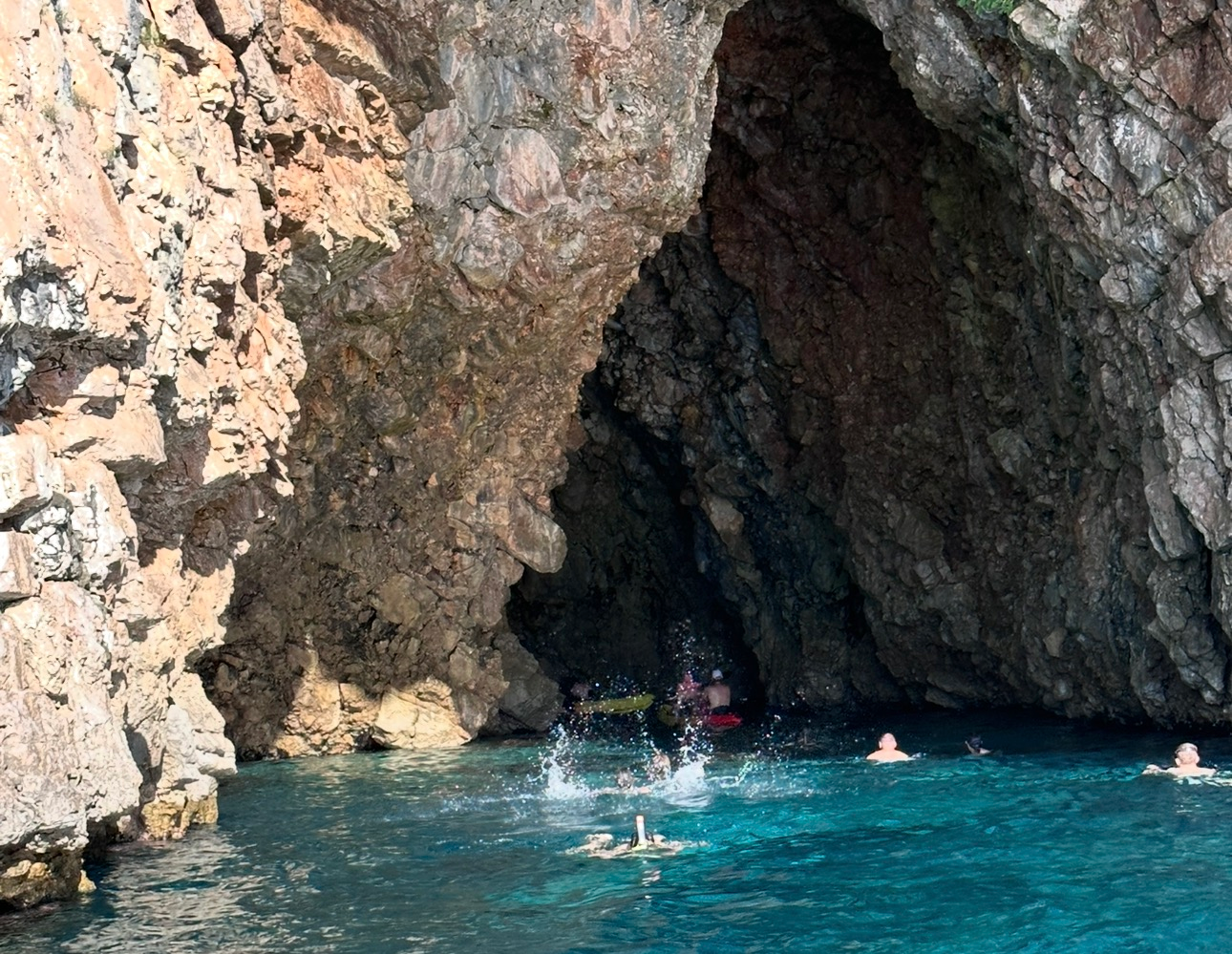
If you’ve seen photos of a cave glowing electric blue from the inside, chances are you’ve already found your reason to visit Montenegro. The Blue Cave (Plava Spilja) is one of the Bay of Kotor’s most extraordinary natural attractions — a sea cave where sunlight enters through an underwater opening and illuminates the interior with an otherworldly blue glow.
But there’s more to it than the photos suggest. Here’s everything we’ve learned from hundreds of visits as local boat captains.
How the Blue Cave Gets Its Colour
The magic is all about physics. The cave has two openings — a main entrance above the waterline, wide enough for a small boat to enter, and a second opening below the surface. When sunlight passes through the underwater entrance, the water acts as a filter, absorbing the red end of the spectrum and allowing only blue light to pass through.
The result is a luminous, almost neon blue that seems to glow from beneath the surface. Objects in the water appear to be lit from within. Your hand, dipped below the surface, looks like it’s been wrapped in blue light. It’s genuinely surreal.
Where Exactly Is It?
The Blue Cave is located on the Lustica Peninsula, near the open sea entrance to the Bay of Kotor. It’s roughly opposite Herceg Novi, carved into the limestone cliffs that form the outer edge of the bay. There’s no road access — the only way to reach it is by boat.
From Kotor, the journey takes approximately 45-60 minutes by speedboat, passing through the Verige strait and along the dramatic coastline of the outer bay. Most tours combine the Blue Cave with other stops along the route — Our Lady of the Rocks, the submarine tunnel, and Mamula Island.
When to Visit: Timing Is Everything
The intensity of the blue glow depends entirely on the angle and strength of sunlight entering the underwater opening. This means timing matters more here than at almost any other attraction in Montenegro.
Best time of day: Between 9 AM and noon. The morning sun hits the underwater entrance at the optimal angle, producing the most intense blue. By afternoon, the angle shifts and the effect diminishes.
Best months: May through September, when the sun is highest and strongest. July and August produce the most vivid colours, but also attract the most visitors. May and June offer nearly identical conditions with far fewer boats.
Weather conditions: A calm, sunny day is essential. Cloud cover dramatically reduces the effect, and rough seas can make it impossible to enter the cave safely. We always check conditions before heading out and will honestly tell you if it’s not a good Blue Cave day.
What to Expect Inside
The cave entrance is approximately 4 metres wide and 3 metres tall — enough for our boats to enter comfortably, but intimate enough to feel like you’re entering a hidden world. Once inside, the cave opens into a chamber roughly 12 metres wide.
The first thing you notice is the silence. The cave muffles the outside world, and the gentle lapping of water against stone creates a meditative atmosphere. Then you look down, and the blue hits you — electric, vivid, unlike anything you’ve seen in nature.
Swimming is allowed and highly recommended. The water inside the cave is typically 1-2 degrees cooler than outside, crystal clear, and the blue effect is even more spectacular when you’re in it. Floating on your back and looking up at the cave ceiling while bathed in blue light is one of those experiences that stays with you.
Combining with Other Stops
We rarely visit the Blue Cave in isolation — it’s part of an incredible stretch of coastline that includes several other must-see stops.
Our Lady of the Rocks: The famous man-made island near Perast, usually the first stop on the journey out from Kotor.
Submarine Tunnel: A Cold War-era tunnel carved into the mountain at the Lustica Peninsula. Originally designed to hide Yugoslav Navy submarines, it’s now an atmospheric attraction you can enter by boat.
Mamula Island: A striking circular fortress built in the 1850s, standing guard at the entrance to the bay. The waters around Mamula are exceptionally clear and perfect for swimming.
Zanjic Beach: One of the most beautiful beaches on the Montenegrin coast, just a short ride from the Blue Cave. Pine trees line the shore, the water is turquoise, and there are several good restaurants.
Practical Tips
- Bring a waterproof phone case — you’ll want photos from inside the cave
- Wear a swimsuit under your clothes so you can jump in quickly
- The cave floor is rocky — water shoes help if you want to stand
- Don’t use flash photography — it ruins the blue effect for everyone
- Morning tours are best for the cave, but they also mean calmer seas overall
- Sea conditions can change quickly — trust your captain’s judgment on whether it’s safe to enter
Is It Worth It?
We’re biased, obviously, but the Blue Cave consistently ranks as the highlight of our guests’ trips to Montenegro. It’s one of those rare natural phenomena that actually exceeds expectations — the photos don’t do justice to the intensity of the blue when you’re inside, floating in luminous water with stone walls rising around you.
Combined with the other stops along the route, a Blue Cave tour becomes a full journey through the best the Bay of Kotor has to offer — history, nature, swimming, and moments of genuine wonder.