
In the heart of the Bay of Kotor, just off the coast of Perast, sits something that shouldn’t exist — an island built entirely by human hands over the course of five centuries. Our Lady of the Rocks (Gospa od Skrpjela) is not just a beautiful church on the water. It’s a testament to the stubborn devotion of the sailors and fishermen who called this bay home.
The Legend Begins: July 22, 1452
The story goes that on a summer day in 1452, two brothers from Perast — sailors returning from a voyage — discovered a small rock barely breaking the surface of the water. On it, they found an icon of the Madonna and Child. One of the brothers was gravely ill, and upon finding the icon, he was miraculously healed.
Word spread quickly through the tiny maritime town. The people of Perast saw this as a divine sign, and they made a vow: they would build an island around this rock and place a church upon it to honour the Virgin Mary.
How Do You Build an Island?
The method was both simple and extraordinary. Every time a Perast sailor returned safely from a voyage, he would drop a rock into the water near the original stone. Over decades, then centuries, the seabed slowly rose. Old ships that had completed their final voyage were deliberately sunk at the site, their hulls filled with stones to create a foundation.
There was even a local law that required every ship passing through the narrows of Verige to drop at least one rock at the site. This tradition, known as fasinada, continues to this day — every July 22nd, locals row boats loaded with rocks out to the island and toss them into the surrounding waters. It’s one of the oldest continuing traditions in the entire Adriatic.
The Church and Its Treasures
By the 17th century, the island had grown large enough to support a proper church. The current structure dates to 1630, rebuilt after an earthquake, and it’s a small masterpiece of baroque architecture that belies the modest size of the island.
Inside, the church holds 68 paintings by the Perast-born artist Tripo Kokolja, who spent 10 years decorating the ceiling and walls. But the most remarkable artwork belongs to a nameless woman from Perast. According to local tradition, she spent 25 years embroidering a tapestry of the Madonna using gold and silver thread — and, when her eyesight began to fail, her own hair. The transition from gold to silver to grey hair is said to be visible in the fabric, making it one of the most poignant artworks in all of Montenegro.
The church also houses a collection of silver votive tablets — small plaques left by sailors as thanks for surviving storms, pirate attacks, and shipwrecks. Each one tells a story of danger and deliverance on the open sea.
Perast: The Town That Built the Island
You cannot understand Our Lady of the Rocks without understanding Perast. In its heyday during the 17th and 18th centuries, this tiny town of fewer than 500 people had a merchant fleet that traded across the Mediterranean. Perast captains served in the navies of Venice, Russia, and the Ottoman Empire.
The wealth that flowed back was poured into 16 churches, 17 palaces, and — of course — the island. The town’s maritime school trained navigators who went on to serve Peter the Great of Russia, and the Venetian Republic entrusted Perast with guarding the entrance to the inner bay.
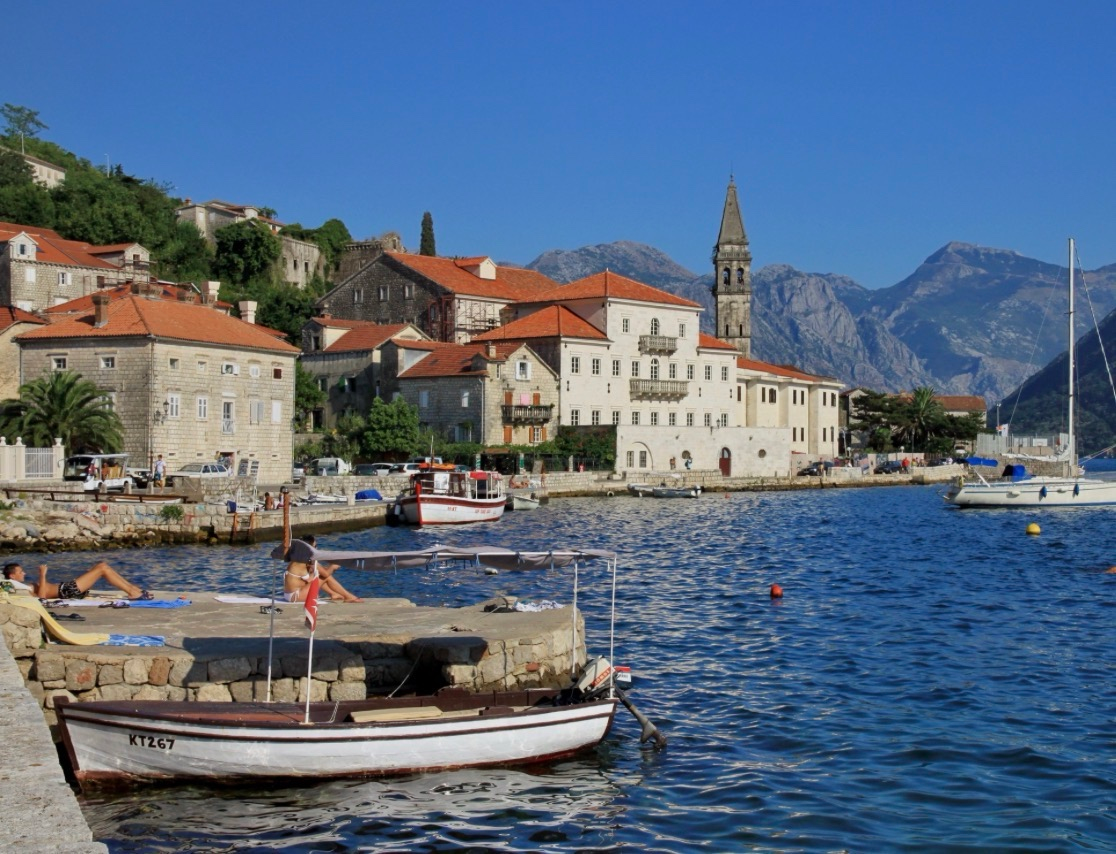
Today, Perast is a perfectly preserved baroque jewel. No cars are allowed in the old town. The palaces stand as they have for centuries, their stone facades reflecting in the still waters of the bay.
Visiting Our Lady of the Rocks Today
The island sits just a few hundred metres off the Perast waterfront. Local taxi boats make the crossing in minutes, but the best way to experience it is as part of a wider boat tour of the bay.
Approaching by boat, you see the church’s blue dome rising from the water, the bell tower catching the morning light, and the dramatic mountains of Orjen forming a perfect backdrop. It’s one of those views that makes you reach for your camera before your brain fully registers what it’s seeing.
The museum inside is small but fascinating — a collection of maritime artifacts, model ships, and those extraordinary votive tablets. Plan to spend 20-30 minutes on the island before continuing your journey through the bay.
The Other Island: St. George
Just a stone’s throw from Our Lady of the Rocks sits the natural island of St. George (Sveti Djordje), topped with a dense cypress grove and a 12th-century Benedictine monastery. This island is privately owned and closed to visitors, which only adds to its mystique. The dark cypresses silhouetted against the mountains have been painted, photographed, and admired for centuries.
The contrast between the two islands is striking — one wild and mysterious, the other bright and built by human devotion. Together, they form one of the most photographed scenes in the entire Mediterranean.
Why This Story Matters
In an age of mega-projects and instant gratification, there’s something deeply moving about a community that spent 500 years building an island, rock by rock, voyage by voyage. Our Lady of the Rocks isn’t just a tourist attraction. It’s a living monument to a community’s faith, perseverance, and connection to the sea.
When you stand on that island and look back at Perast, with its palaces and bell towers reflected in the still water, you’re seeing a story that stretches back half a millennium — and one that continues every July, when the boats go out and the rocks splash into the water, adding another layer to an extraordinary human achievement.