
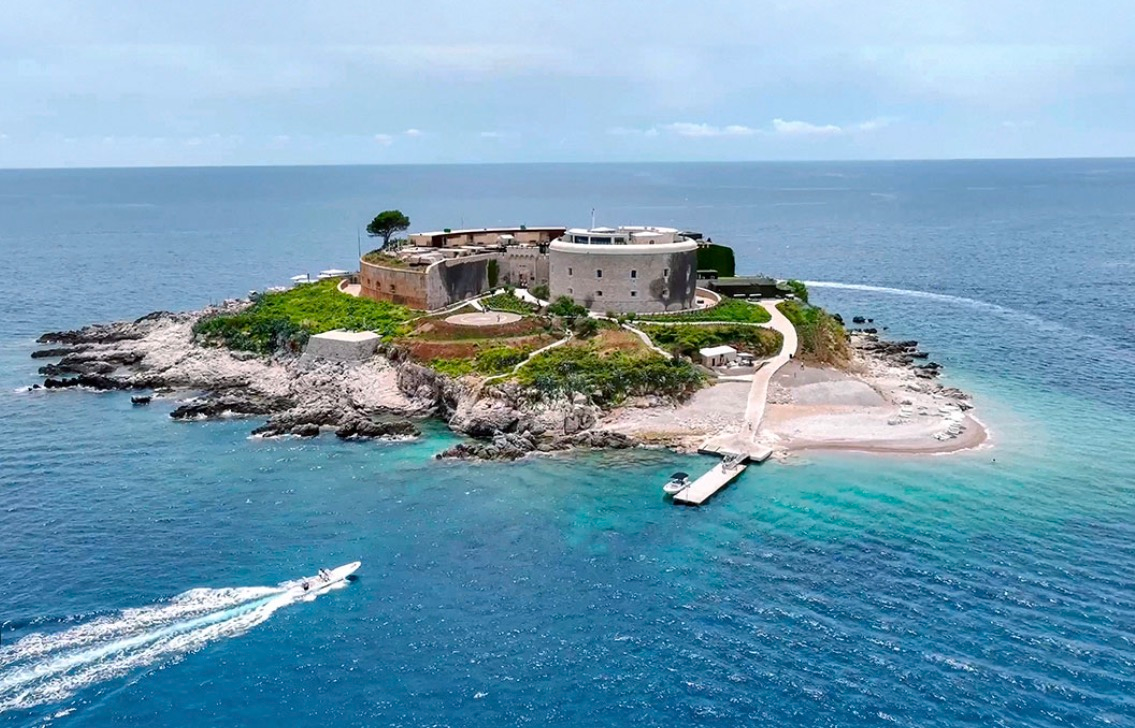
At the very mouth of the Bay of Kotor, where the sheltered waters meet the open Adriatic, sits a small circular island crowned by an imposing stone fortress. Mamula Island is barely 200 metres in diameter, yet its history spans empires, wars, and some of the darkest chapters of the 20th century.
For visitors approaching by boat, it’s an arresting sight — a perfect circle of weathered stone rising from turquoise waters, with the dramatic cliffs of the Lustica Peninsula behind it and the open sea ahead. But the island’s story is far more complex than its beauty suggests.
The Austrian Fortress (1853)
Mamula owes its current appearance to General Lazar Mamula, a Serbian-born military commander serving the Austrian Empire. In 1853, he ordered the construction of a circular fortress on the uninhabited island to defend the entrance to the Bay of Kotor — one of the Adriatic’s most strategically important natural harbours.
The fortress was a masterpiece of 19th-century military engineering. Its circular design maximised defensive coverage, with cannon positions covering every approach. The walls were thick enough to withstand naval bombardment, and the island’s position at the narrowest point of the bay entrance meant that no ship could enter or leave without passing within range.
The fortress was part of a larger defensive system that included batteries on both sides of the strait and a chain that could be stretched across the channel to block enemy vessels. Together, they made the Bay of Kotor one of the most heavily defended natural harbours in the Mediterranean.
The Dark Years: World War II
Mamula’s darkest chapter came during World War II. The Italian occupying forces, and later the Germans, converted the fortress into a concentration camp for political prisoners, partisans, and civilians from the surrounding region.
Between 1942 and 1944, the island held hundreds of prisoners in conditions of extreme deprivation. The fortress cells, designed for ammunition storage, became cramped holding areas. Prisoners were subjected to forced labour, starvation, and worse. Many did not survive.
After the war, a memorial was erected on the island to honour those who suffered and died there. This history gives Mamula an emotional weight that goes beyond its striking appearance — it’s a reminder that even the most beautiful places can carry dark memories.
Post-War Abandonment
After World War II, the fortress lost its military purpose. Yugoslavia’s defence strategy focused on different locations, and the island was effectively abandoned. For decades, Mamula sat empty, gradually being reclaimed by nature. Wild fig trees pushed through the stonework, birds nested in the gun emplacements, and the sea slowly eroded the lower walls.
During this period, the island became popular with local swimmers and adventurous visitors who would boat out to explore the ruins. The waters around Mamula are exceptionally clear — the island’s position in the strait means strong currents keep the water pristine — and the rocky shores provide excellent swimming and snorkelling spots.
Visiting Mamula Today
Today, Mamula Island is one of the most photographed landmarks in the Bay of Kotor. Most visitors experience it from the water as part of a boat tour — the island is a natural stop between the inner bay attractions and the Blue Cave.
Approaching by boat, the fortress fills the horizon with surprising drama for such a small island. The circular walls, punctuated by arched windows and cannon ports, create a silhouette that feels almost cinematic.
The waters around the island are among the clearest in the bay, making it a popular swimming stop. The seabed around Mamula is rocky and full of marine life — sea urchins, small fish, and colourful algae are visible from the surface.
The Bigger Picture
Mamula Island encapsulates the entire history of the Bay of Kotor in miniature. It has been shaped by every power that controlled these waters — Venetians, Ottomans, Austrians, Italians, Germans, Yugoslavs, and now Montenegrins. Its walls have served as defence, prison, and now landmark.
When you pass Mamula on a boat tour, you’re passing through a geographical and historical gateway. Behind you lies the sheltered, intimate world of the inner bay — Kotor, Perast, Our Lady of the Rocks. Ahead lies the open Adriatic, the Blue Cave, and the beaches of the outer coast. Mamula stands at the threshold between these two worlds, as it has for nearly 200 years.
That’s what makes it such a compelling stop on any Bay of Kotor itinerary — it’s not just a beautiful ruin on a pretty island. It’s a place where history, geography, and the raw beauty of the Montenegrin coast all converge.